Modern Minimalist: How Simplicity Shapes Today’s Lifestyle
Simplicity as a Path to Long-Term Fulfillment


In the last few years, much attention has been paid to modern minimalism. From a lifestyle of simplicity and intentional living, it has evolved beyond the movement to meet the ever-increasing demand for clarity, balance, and meaning in today’s fast-moving world. Minimalism allows one to thoughtfully consider how to navigate the complexities of modern life through a focus on quality over quantity.
Why Minimalism Is Becoming More Popular
As daily demands surge and information flows continuously, many people feel an urge to create more space—both physical and mental. Thus, minimalism is a workable solution that can provide calm and order. Fewer possessions equate to fewer distractions, thus creating room to breathe and think.
Besides, as people become more sensitive to mental health, it seems natural to move away from an over-consumption approach. Simplifying one’s options and commitments will help someone feel less overwhelmed and more clear about priorities.

How Simplicity Closes the Quality Gap
Minimalism is not about just cleaning up or donating things that are not in use. More importantly, minimalism affects how people think, feel, and behave in everyday life:
- Financially, it facilitates more mindful spending and superior budgeting.
- Emotionally, it encourages thankfulness and satisfaction.
- The organized environment productively enhances focus and efficiency.
In turn, minimalism generates a sense of peace that is seldom viewed as important in a fast-paced lifestyle.
Minimalism in Modern Living Spaces
Minimalism, when applied to interior design, adopts clean lines, soft neutral tones, and effective spatial arrangements. This makes homes feel more open and calming even within compact urban spaces.
Besides, multifunctional furniture supports practicality but does not forget aesthetic balance. Such a combination helps make the living space a sanctuary-one that offers comfort after busy days.
Technology’s Role in a Minimalist Lifestyle
Although minimalism promotes reducing physical possessions, technology surprisingly plays an important role in supporting it. Digital tools simplify many aspects of life-payments, documents, entertainment, and communication-which enable people to own less while doing more.
But balance is imperative. Digital minimalism calls for the thoughtful curating of digital consumption to avoid information overload and preserve clarity of mind.
How to Get Started with Minimalism
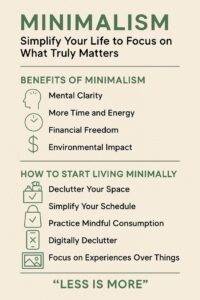
Minimalism is not about making radical changes in your life or overnight transformations. Small, but continuous steps would do more:
- Get rid of things no longer serving a purpose.
- Make purchases based on real needs, not on impulse.
- Clean up the workplace and living area to increase productivity.
- Organize and plan time deliberately in order to avoid overwhelm.
In these practices, simplicity becomes a frame of mind, not merely an aesthetic.
Conclusion: Simplicity as a Life Investment
Ultimately, modern minimalism is not about self-limitation or living with hardly anything. Rather, it is about focusing one’s attention on what truly counts. By living a more intentional simplicity, individuals are able to cultivate calmness, clarity, and deeper fulfillment.
Thus, minimalism is not a temporary trend, but rather a long-term investment in personal well-being, both physically, mentally, and emotionally.